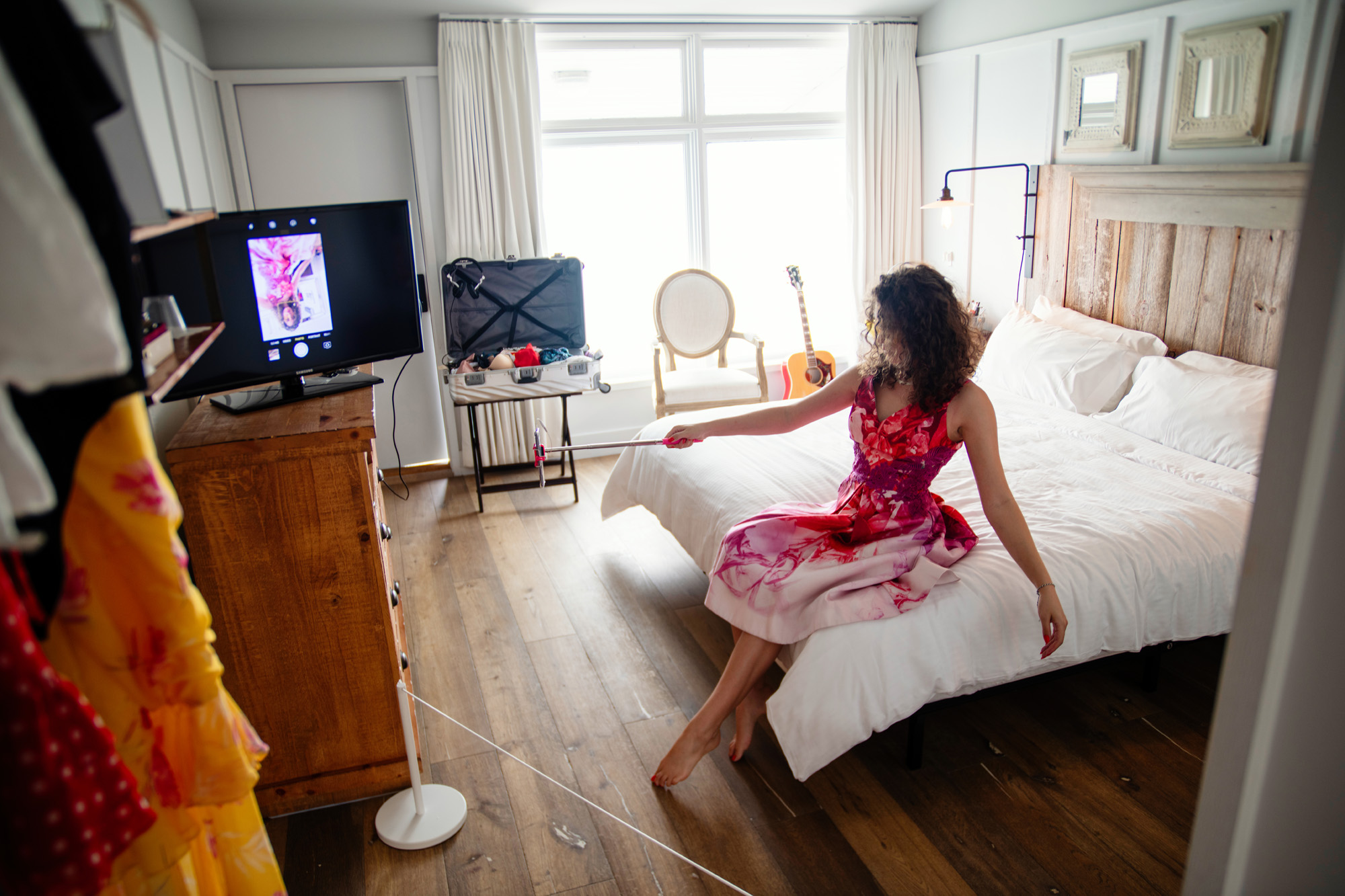
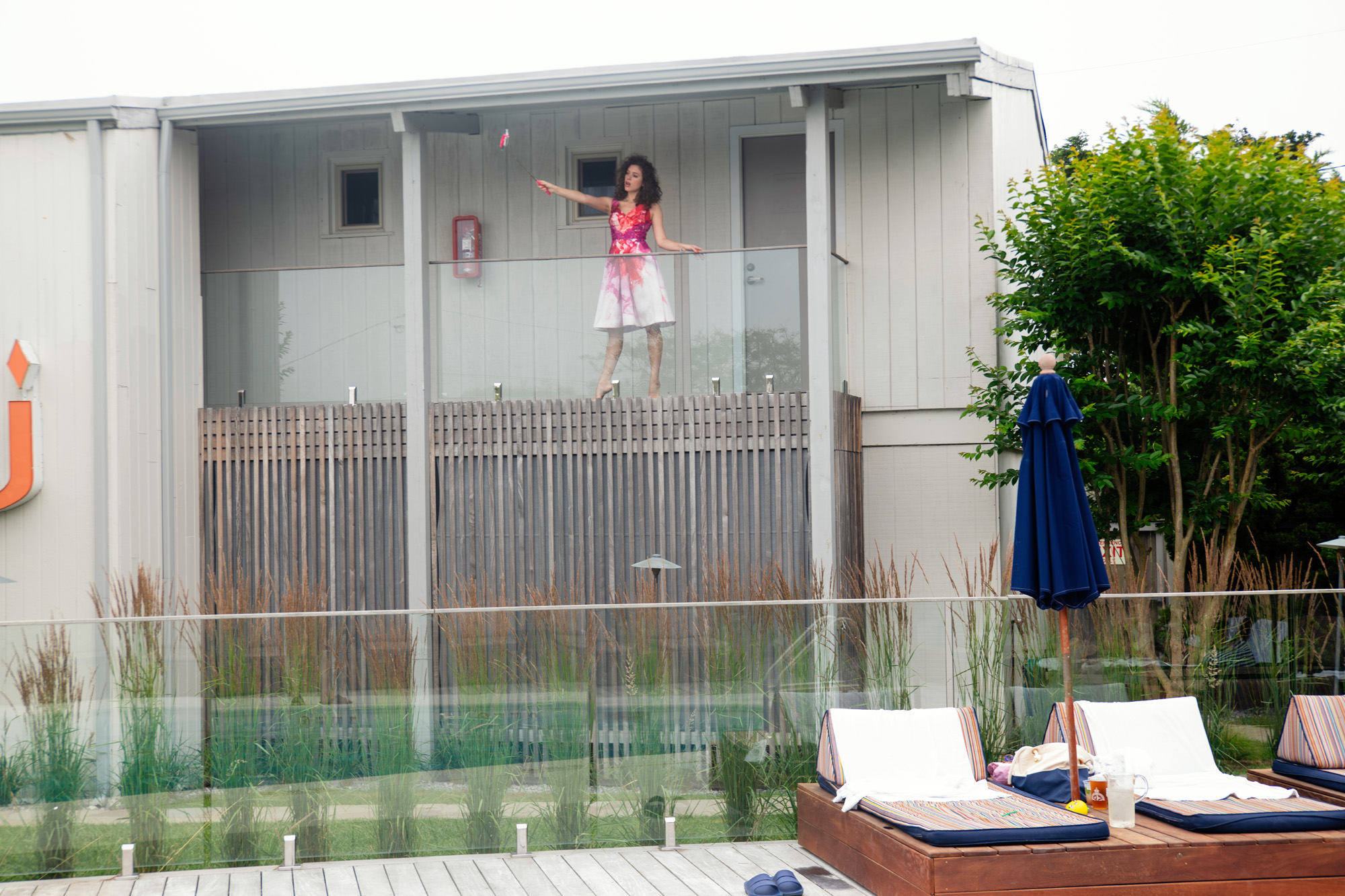
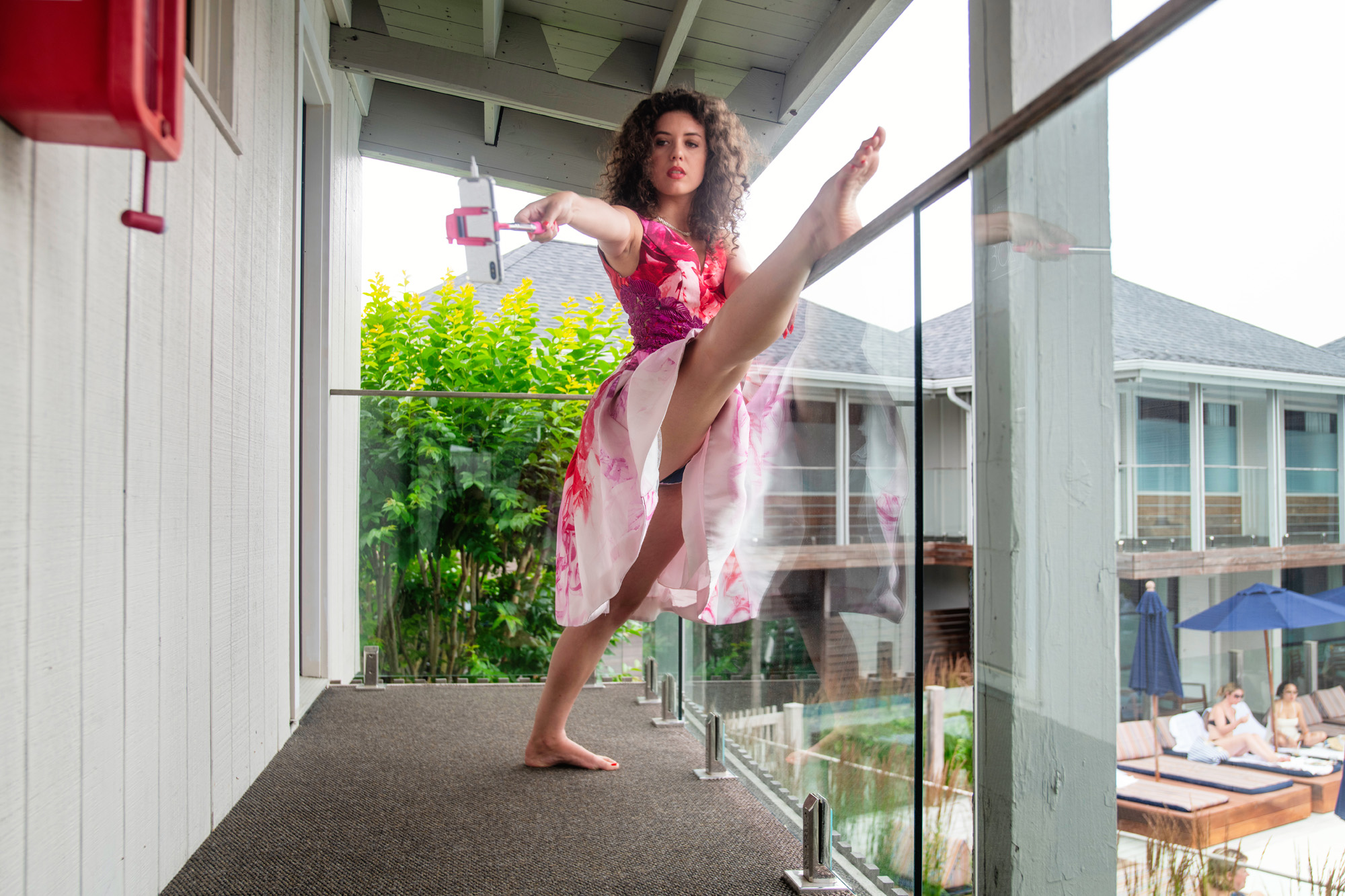
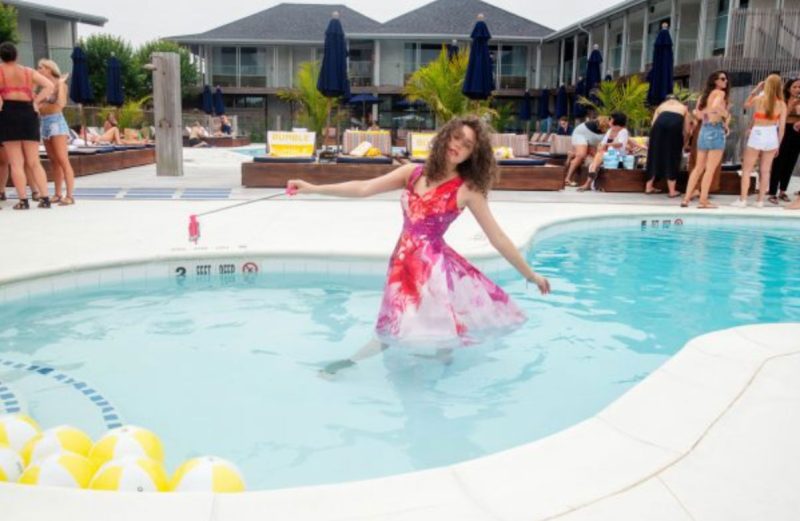
In the summer of 2019, I presented Angles on a Woman, my first live performance, at the Montauk Beach House as part of my solo exhibition Unprotected Specs. The performance made public the process behind my photographs and investigated Jacques Derrida’s observation that photography is “as much production as recording of images, as much act as gaze, as much performative event as passive archivization.”
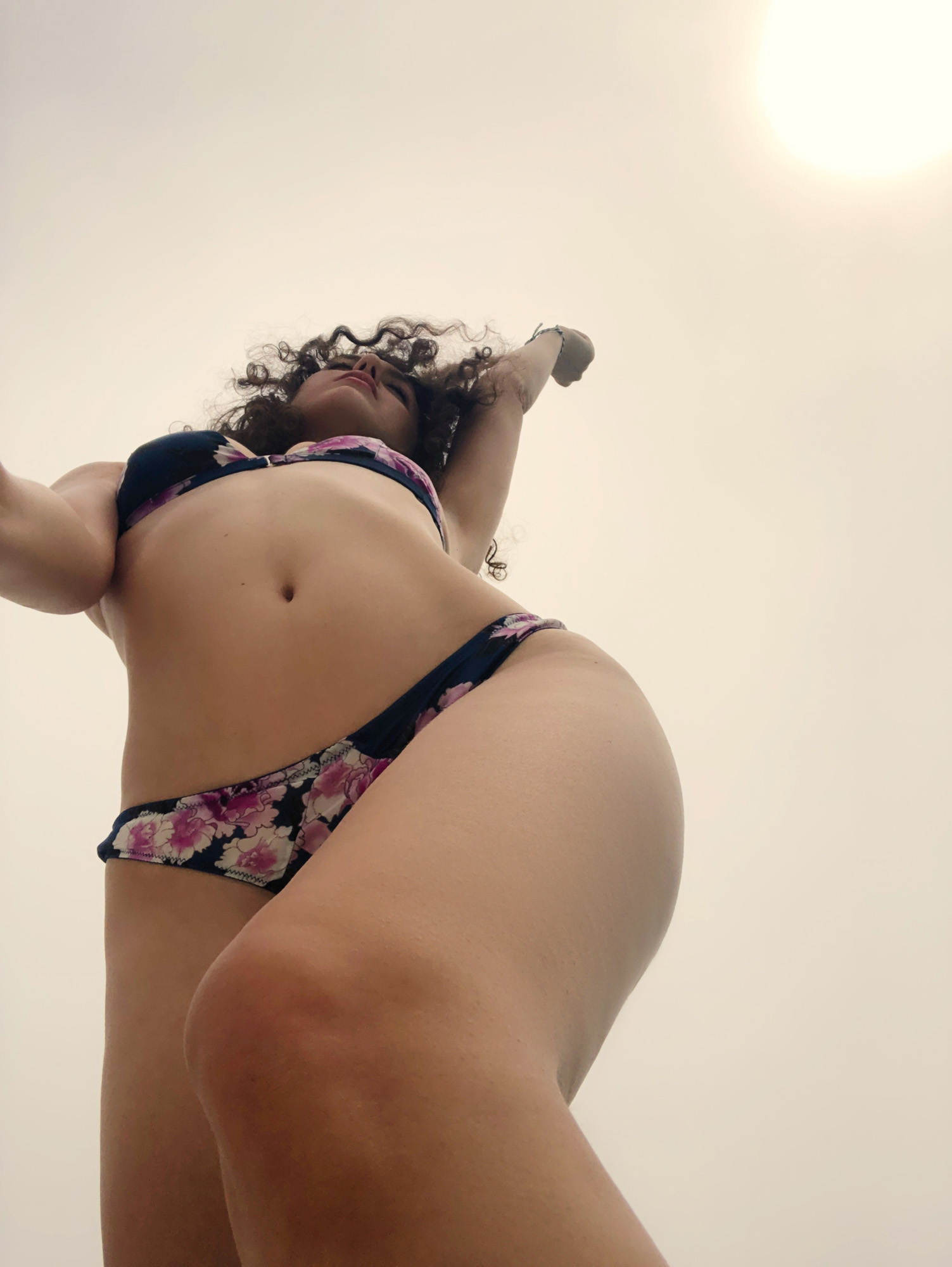
Much of my work begins in hotels and home shares such as Airbnb where I photograph myself performing for the camera. The resulting images are then selected, retouched, digitally painted, and distributed across multiple online identities. Angles on a Woman translated that normally private workflow into a live performance.
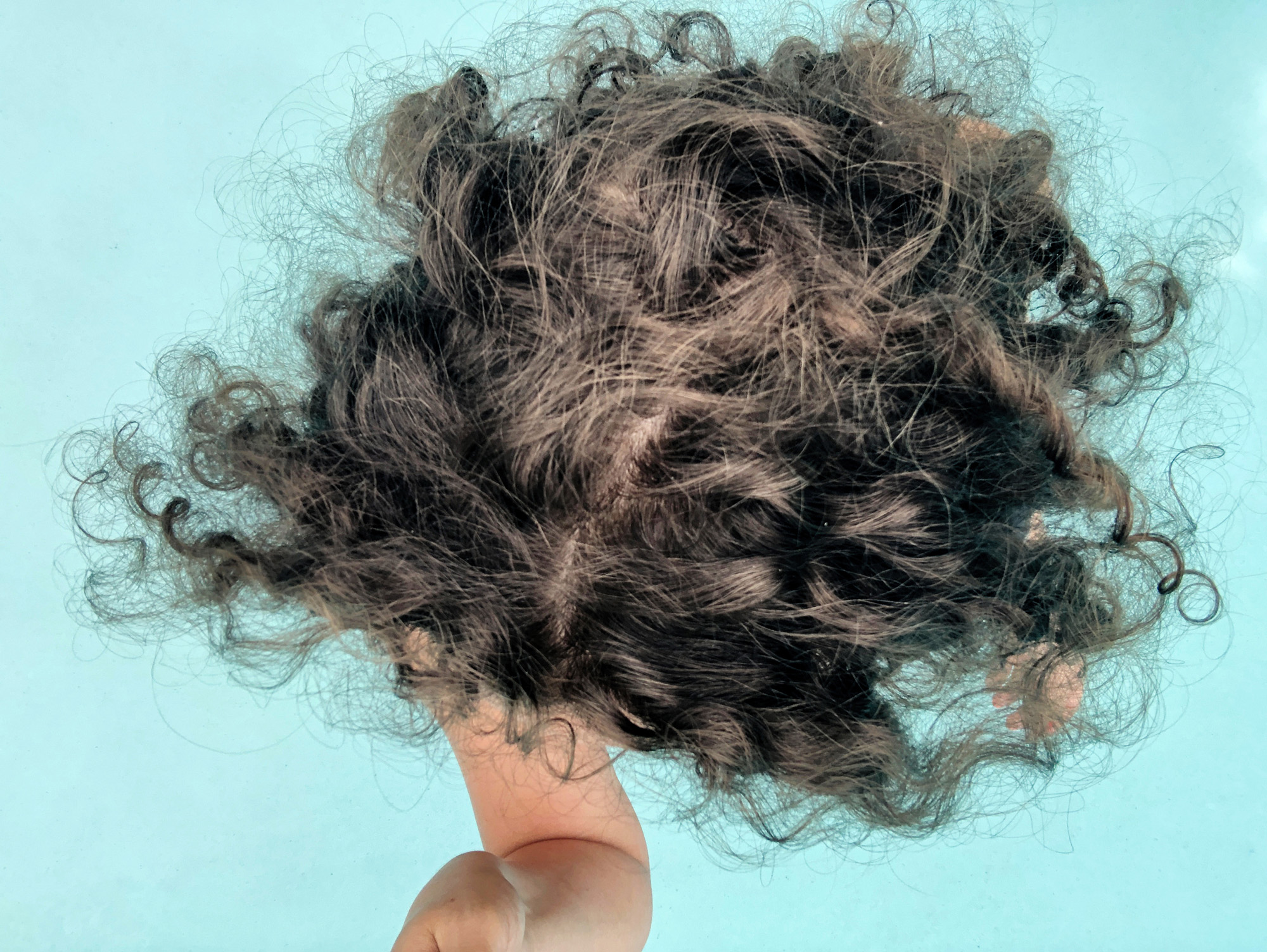
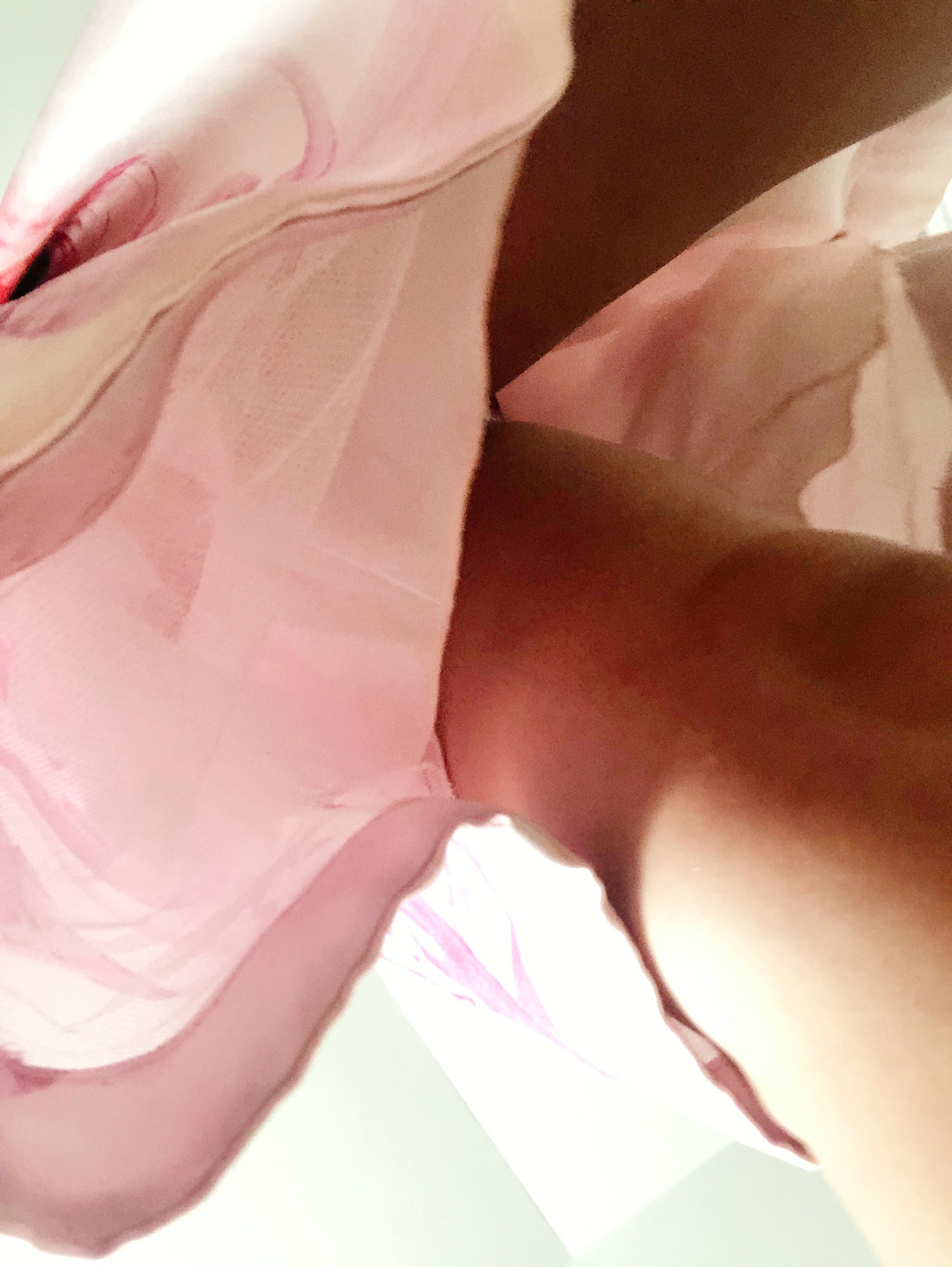
The work unfolded in three acts: Photoshoot, Processing, and Posting. Remaining in the same costume and setting, I embodied multiple versions of the same woman through changes in camera angle, physical pose, expression, and the moment of capture. During the final act, the completed images were posted live to three different Instagram accounts, including @OnaArtist, my celebrity-as-art project, which ultimately grew to more than five million followers.

Press
Statement
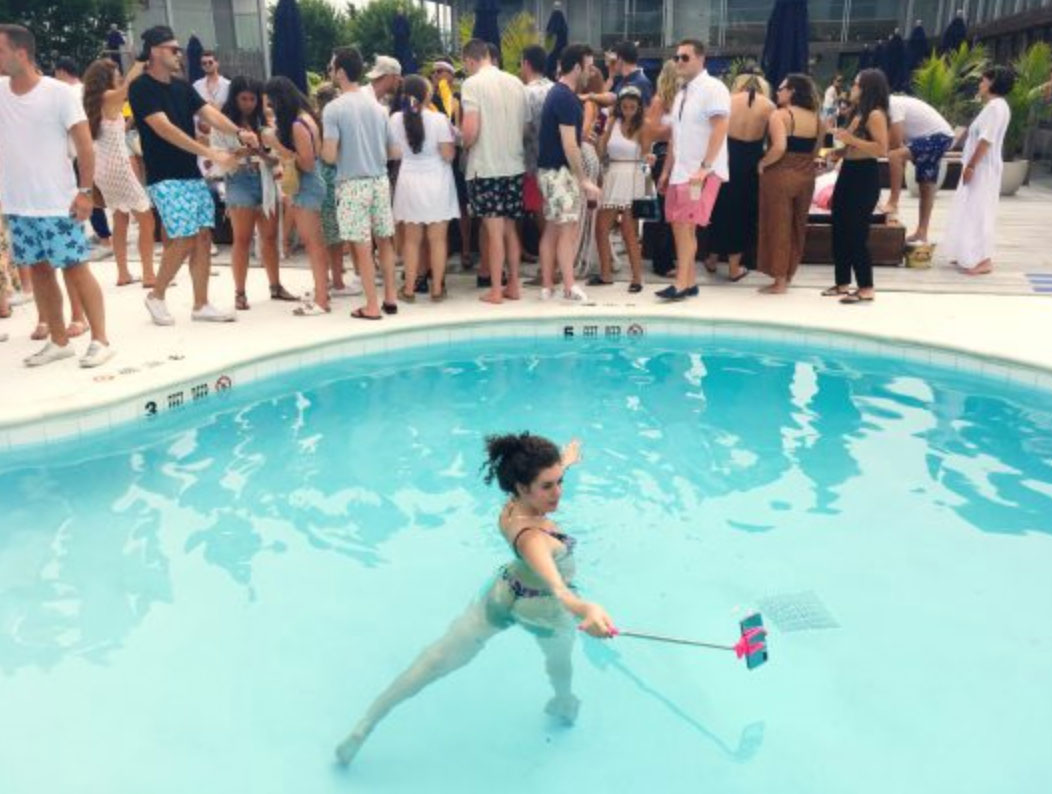
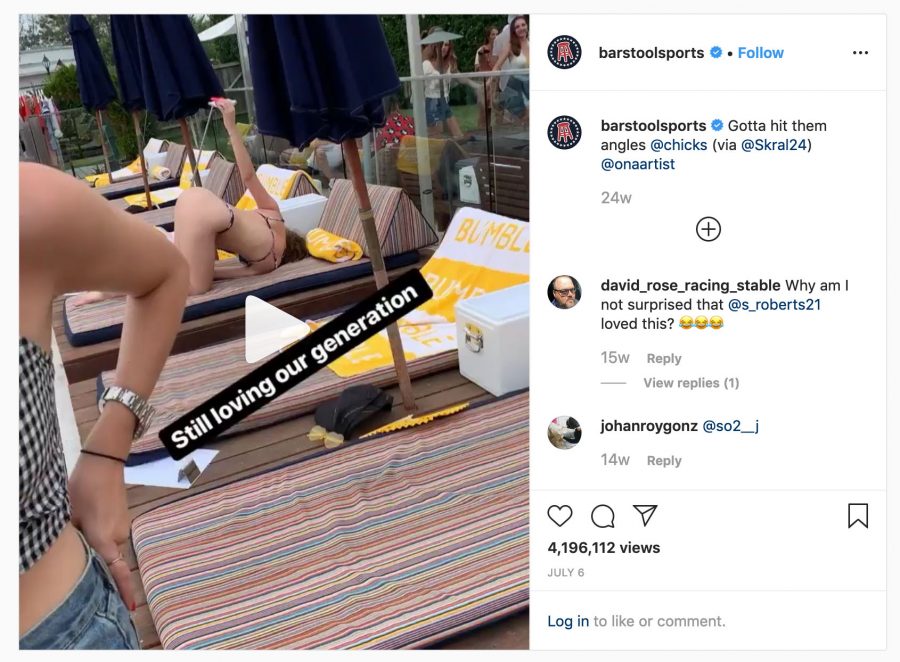
The performance quickly extended beyond the gallery when an audience member recorded and shared a short video online. The clip reached more than 40 million viewers, bringing questions the work raised inside the exhibition into a much broader public conversation. The following statement was released in response.
Unbeknownst to her, one guest captured a short video clip of her performance and posted it to @BarStoolSports (6.8m followers). The video has since gone viral and been seen by over 40 million viewers.
During the performance, the crowd reacted with a mix of curiosity, surprise, and enthusiasm. Some joined in and had their photographs taken with Schrager, others asked, “What is this all about?” and some audibly gasped when she struck the signature pose captured in the viral clip. Online, the responses were equally varied. Some commenters dismissed the work with remarks such as “your parents must be so proud,” “why women can’t get equal pay,” or “she’s shooting her ass for a porn site—not art.” Others responded quite differently, writing “this girl is an innovator,” “the next Kim Kardashian in the making,” or “your performance art inspired my quilted self-portraitures throughout undergrad.”
Angles on a Woman was the performative element of Schrager’s exhibition Unprotected Specs, presented by Roman Fine Art at the Montauk Beach House. The exhibition also included an opening reception and an artist conversation with journalist Nicole Teitler. The unexpected circulation of the performance beyond the art world ultimately became an extension of the work itself, demonstrating how images change meaning as they move between artistic, commercial, and social contexts.
“I was performing in order to explore the ways in which various angles are used in selfie-taking to generate different genres of digital female presentation,” Schrager says. “I also posted certain images, depending on the angle achieved, on one of my online profiles. But in the clip that went viral, I was performing as @OnaArtist, my Instagram model persona.” Schrager found it telling that the video’s caption—”gotta hit them angles”—and the thousands of comments discussing “angles” echoed one of the central ideas of the performance itself.
Schrager also found it significant that the work circulated without crediting either the artist or the artwork, and that she was repeatedly referred to as a “thot” in thousands of comments. “To have a short clip of this complex process reduced to ‘just some girl trying to get attention’ felt both like an affirmation of my investigation and an illustration of how women continue to be understood primarily through the images they produce. The question became: am I a thot or an artist, and what is the difference?”
After the video spread, Schrager spent considerable time asking large social media accounts to identify her as the model. Rather than simply seeking attribution, she viewed the absence of credit as part of the work’s larger investigation into authorship, image ownership, and the circulation of photographs online.
Owning her image has remained central to Schrager’s practice. Working as the photographer, model, artist, and distributor of her own images, she investigates how women construct, circulate, and retain agency over their representations through photography, performance, and digital media.