Naked Therapy was an online social practice performance founded under the pseudonym Sarah White in 2010. Conducted through one-on-one video sessions, the project explored intimacy, sexuality, and the role of arousal in human behavior. At the same time, it became an experiment in self-representation. Through the project I began to explore how a woman could construct and transform her identity online.
At the time I had recently moved to New York City, where I was pursuing dance while supporting myself through catering jobs. My artistic education came largely from museums, artist talks, and conversations. I didn’t really know what I was doing, but the internet seemed like fertile territory. The project began when I launched a website offering the service.
Anonymity was central to the project. Sarah White was not simply a pseudonym but a performative identity that allowed me to explore questions of gender, desire, confession, and projection. The internet itself functioned as both medium and site. The work existed within the aesthetics and technologies of early Web 2.0 culture—video chat, personal websites, and email—at a time when these spaces were transforming how people formed relationships and constructed identities.
Between 2010 and 2015, Sarah White conducted thousands of sessions with hundreds of men. The project generated a substantial archive of conversations, photographs, writings, and artworks. Through these interactions, Naked Therapy developed into an ongoing investigation of intimacy, identity, desire, and human relationships. It was a social practice project that genuinely existed first and foremost for the people taking part.
The project unexpectedly entered mainstream culture when it went viral in 2011, generating widespread media attention and appearances across television, newspapers, magazines, and online publications. The response revealed both the difficulty many people had with the idea itself and the challenge of categorizing the work. Was it therapy, performance, entrepreneurship, activism, pornography, social practice, or conceptual art? Was it even allowed? The inability to agree became part of the work itself.
That tension came to a head in 2012 when I was removed from the West Chelsea Artists Open Studios after being told that my work was an advertisement rather than art. The controversy sparked discussion throughout the New York art world about authorship, commerce, censorship, and the treatment of women who use their bodies as artistic material. It was my first direct encounter with the institutional boundaries that separate art from commerce, artist from subject, and often women from authorship of their own image.
When I entered graduate school, I publicly revealed myself as the person behind Sarah White and the project came to an end. Looking back, Naked Therapy became the foundation for much of my later work. It established many of the questions that continue to shape my practice today: the relationship between identity and performance, the role of technology in human connection, the circulation of images online, and the complicated ways women navigate visibility, self-representation, and public life.
About Naked Therapy
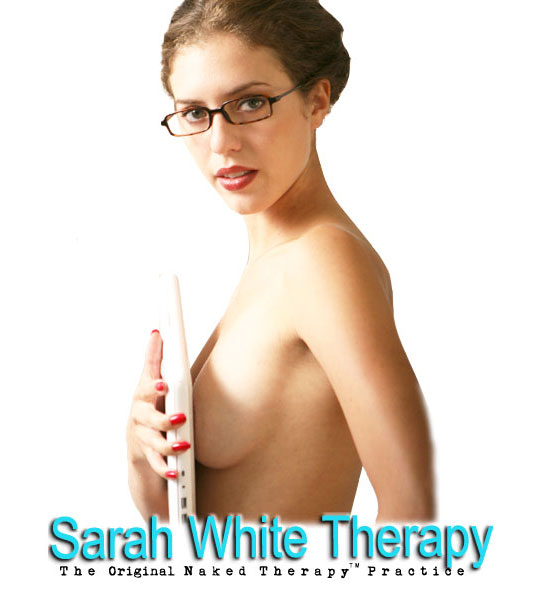
Naked Therapy (NT) is a form of talk therapy conducted via video cam and founded by Sarah White in 2010. White conducted thousands of hour-long sessions. During a session, the client and/or therapist may become naked in order to facilitate greater client insights. The website remains at SarahWhiteTherapy.com.
NT can be understood as a feminist version of Freudianism, and the two practices share similar origins. Freud treated turn-of-the-century women, while White treated turn-of-a-different-century men. Freud’s practice emerged from mesmerization, achieved through hypnosis, and the accompanying discovery of the unconscious. Naked Therapy emerged from a new form of mesmerization—men in states of online arousal—and the accompanying concept of the “arousal brain.” In both cases, accessing these altered states allows for transference, self-reflection, and transformation.
Naked Therapy was a real therapeutic practice. For me, it also became the foundation of an artistic investigation into sexuality, intimacy, technology, performance, and human behavior in the early internet era.
Art Controversy
In 2012, I was removed from the West Chelsea Artists Open Studios after organizers determined that my work was an advertisement rather than art. The decision sparked discussion throughout the New York art world about authorship, commerce, censorship, and the role of the female body in contemporary art. The controversy became an important moment in the development of my practice, forcing me to confront questions about who gets to be recognized as an artist, and under what conditions. A more detailed account of the event, including press coverage and my original statement, can be found here.
Art & Documentation
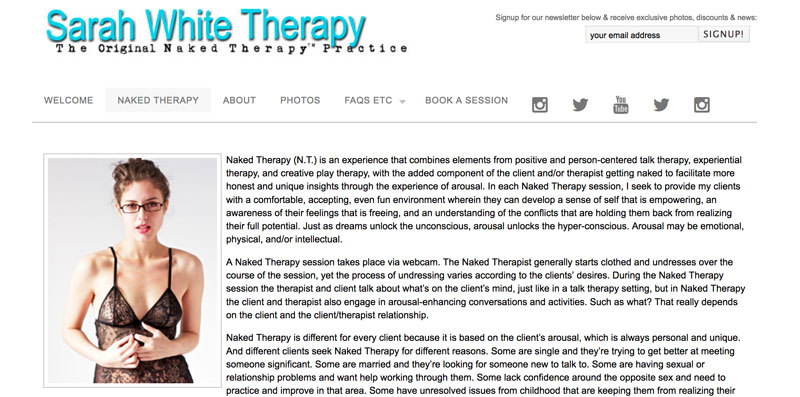
Screenshot from the 2010 website.
Informational video from 2012.
Video commissioned by The Museum of Sex for their 2020 show Cam Life.
During this time I also created artworks. Rather than documenting Naked Therapy directly, many of these projects explored its traces, participants, and psychological dynamics. The following series emerged from the practice.
Floor Photos: A photograph made immediately after a Naked Therapy session. The images document the physical traces left behind after an encounter while withholding the encounter itself.
Portraits of Men: Portraits made in collaboration with participants, accompanied by interview texts. The series examines vulnerability, desire, projection, and self-representation from the perspective of the men who took part.
Self-Rorschachs: Images that layer internal emotional states and external environments onto my body, using the logic of the Rorschach test as a framework for self-analysis.
Photoanalysis: Collaborations with photographers in which the photographic session itself became the subject. The resulting images, videos, and conversations explore authorship, objectification, performance, and the relationship between photographer and model.
Press
Naked Therapy attracted significant media attention following its viral emergence in 2011. The project was covered by major newspapers, magazines, television programs, and online publications around the world, including appearances on The Tonight Show with Jay Leno, coverage in The Wall Street Journal, New York Daily News, Huffington Post, and many others. The breadth of the response reflected both public fascination with the project and the difficulty many people had determining exactly what it was. The articles, interviews, and broadcasts document the public life of the project.